
Autonomes Fahren mit AULA-KI
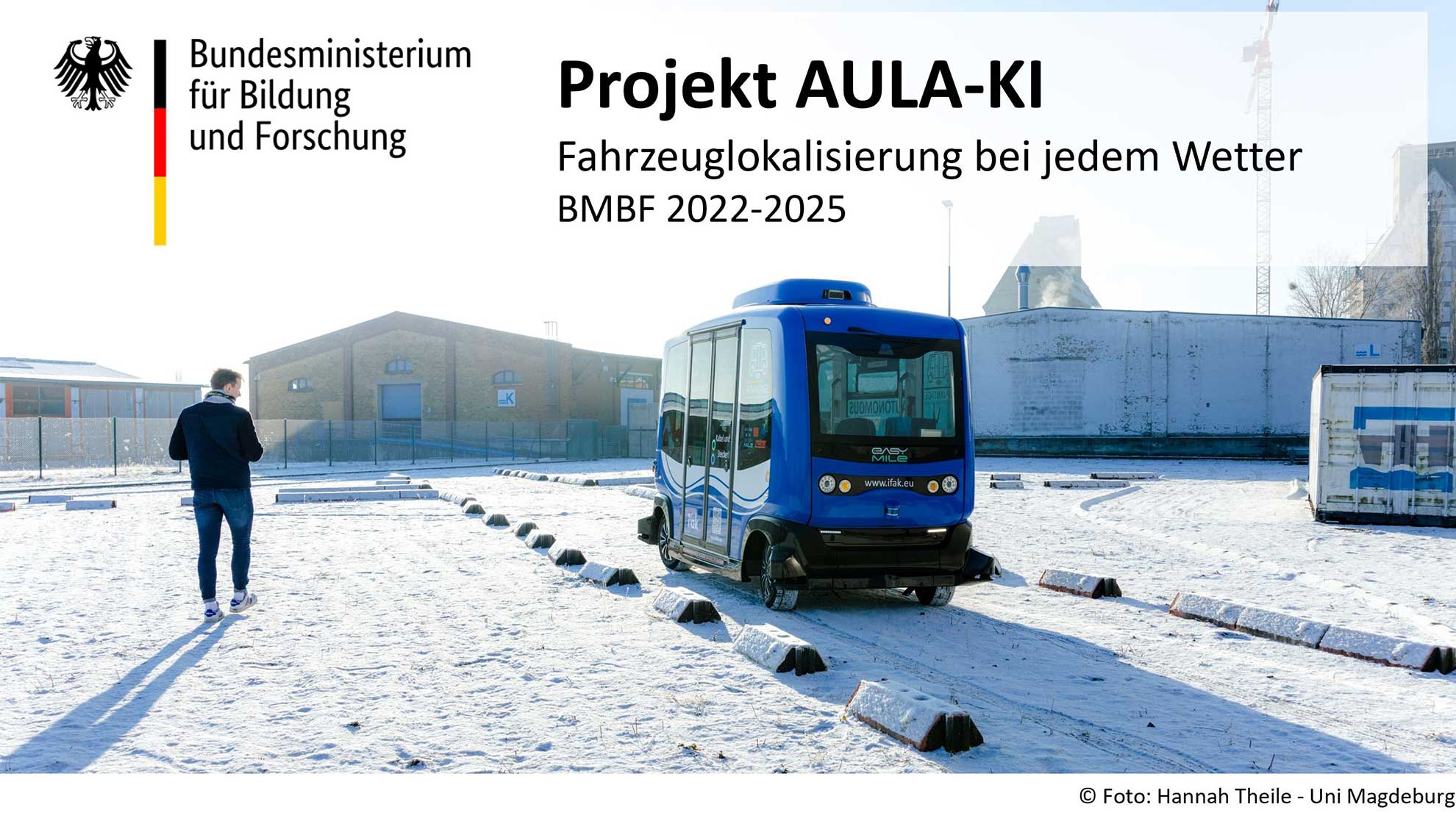
Das Forschungsprojekt AULA-KI entwickelt KI-gestützte Verfahren, die autonomes Fahren bei Regen, Schnee, Nebel oder Bewuchs auf der Fahrbahn sicherer und zuverlässiger machen. Denn autonome Fahrzeuge müssen nicht nur ihre Umgebung erfassen, sondern auch erkennen, wann ihre eigenen Sensordaten durch Wetter und Umwelt nicht mehr verlässlich sind.
AULA-KI verbindet maschinelles Sehen mit KI-basierter Selbsteinschätzung: Störungen in Sensordaten werden zuverlässig detektiert, wo möglich kompensiert und bei kritischer Unsicherheit eine sichere Reaktion ausgelöst (z. B. kontrolliertes Anhalten). Die entwickelten Konzepte wurden bereits teilweise in Software umgesetzt und auf einem autonomen EasyMile-EZ10-Shuttle am Galileo-Testfeld in Magdeburg erprobt.
Parallel stärkt AULA-KI eine gemeinsame Kompetenzbasis von OvGU und ifak e. V. für Reliable AI in industriellen und Mobilitäts-Anwendungen — mit klarem Fokus auf Transfer in konkrete Use-Cases und Anschlussprojekte.
ENGLISH - Autonomous driving with AULA-KI (Robust AI solutions for autonomous driving in bad weather.)
The AULA-KI project develops AI-based methods that make autonomous driving safer and more reliable in rain, snow, fog, or vegetation on the road. When weather and environmental effects degrade sensor data, autonomous systems must not only “see” the world — they must also know when their own measurements are no longer trustworthy.
AULA-KI combines perception with AI-based self-assessment: the system detects weather- and environment-induced disturbances in sensor data, compensates them where possible, and triggers a safe reaction (e.g., controlled stopping) when reliability drops below a critical threshold. The concepts have been partially implemented and tested on an EasyMile EZ10 shuttle at the Galileo test field in Magdeburg.
At the same time, AULA-KI strengthens a joint competence base at OvGU and ifak e.V. for developing reliable AI methods for industrial and mobility applications — with a clear focus on transfer to real-world use cases.